
Before enrolling in Lewis & Clark Law School’s Master of Science in Law (MSL) program, Nick Thierry spent a decade working at publicly traded renewable energy companies and utilities. His work spanned community engagement, renewable energy policy, environmental justice advocacy, and sales. As renewable energy, electric vehicles, and home electrification began to scale, he increasingly focused on addressing how and where that growth would happen.
“I had reached a stage in my career where I was becoming a subject matter expert, but the list of lingering questions unrelated to energy or advocacy continued to grow,” he says. “I wanted to get those questions answered by experts who had lived experience in environmental law, land conservation, and international climate policy.”
That search led him to Lewis & Clark’s environmental law MSL program and ultimately helped shape the next chapter of his career.
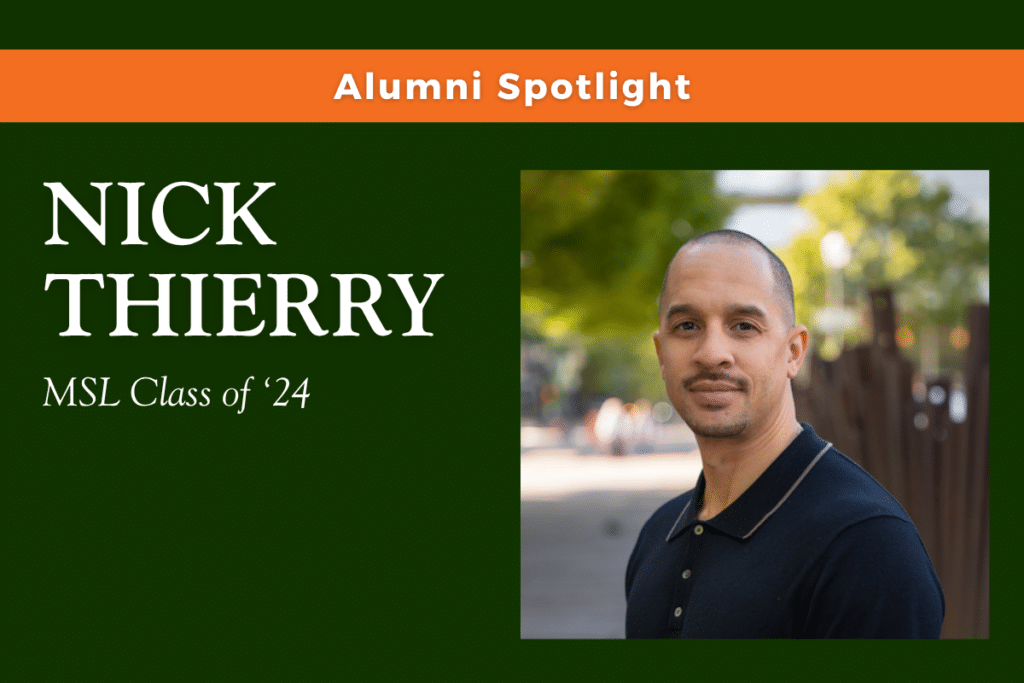
Building on a Career in Environmental Advocacy
Nick was established in his career when he began considering an MSL. He wasn’t looking for a degree simply to qualify for a new job. Instead, he wanted to deepen his understanding of the legal and policy frameworks surrounding the environmental issues he encountered every day.
“I knew the MSL was a place where I could engage and grow alongside faculty and students who cared about the environment and communities just as I did. It was a desire to see what was possible once those collaborations took place. The MSL raised the ceiling on my understanding of all things environmental in a way I didn’t think possible.”
For an experienced environmental professional, that deeper understanding of law, policy, and environmental issues can provide a valuable perspective on the decisions shaping communities and organizations.
Why Choose Lewis & Clark for Environmental Law?
Nick completed his undergraduate degree at Lewis & Clark College in 2009 and remembers walking through the law campus and listening to conversations among students and professors. At the time, he wasn’t part of those conversations, but he remembers thinking about the caliber of environmental discussions taking place around him. Years later, when he began looking at graduate programs, that impression stayed with him. “Lewis & Clark’s campus is truly remarkable. It’s a great place to learn, with even greater people to learn from.”
Lewis & Clark ultimately stood out because of the breadth of its environmental law curriculum. “I was looking for a very robust experience in what I thought were very niche interests: Environmental justice meets hazardous waste meets climate finance,” Nick says. “Lewis & Clark offered multiple courses on each of these topics, making it a no-brainer.”
Learning Environmental Law and Environmental Justice From Leading Experts
“I had an amazing experience in the program,” he says. “It pushed me to my intellectual limits and gave me a chance to envision more for myself and the world.” Another defining part of his experience was the opportunity to learn from Lewis & Clark Law School faculty. He points specifically to Professor Lisa Benjamin and Professor Melissa Powers as two professors who had a significant impact on him, both because of their expertise and because “they both do an amazing job relating to students.” The learning environment as a whole was, “welcoming, supportive, and rigorous.”
Balancing an MSL With a Full-Time Career
Nick worked full-time throughout the program, making the flexibility of the MSL particularly important. He completed coursework early in the morning and on weekends while continuing his professional responsibilities. The experience required some rearranging and sacrifice, but Thierry says the investment was worth it.
He also saw a direct career return while he was still enrolled. “I was promoted one year into the program, so it paid for itself before I graduated. The residual return and the network I am in now as an alumnus are hard to quantify, but I am glad I made the decision a few years ago to apply.”
From Environmental Law Student to Environmental Entrepreneur
During the MSL program, Nick began developing ideas that would eventually become FrontDoorFax, a company focused on helping people better understand environmental and health risks associated with where they live. The idea grew out of nearly 15 years of listening to residents, community organizers, and local leaders talk about the challenges facing their neighborhoods. Thierry wanted to create a way to address some of the information gaps he repeatedly encountered.
FrontDoorFax focuses on issues including climate literacy, environmental justice, the built environment, health equity, and fair housing. For Nick, the goal is straightforward: give people more information about the environmental factors that can affect their homes, health, and investments so they can make more informed decisions. He launched the company shortly after graduating from the MSL program.
Applying Environmental Law and Policy to Real-World Problems
Nick describes FrontDoorFax as the “greatest hits” of his previous professional experience. His background in renewable energy, environmental policy and advocacy helped shape the company’s approach, while his MSL experience gave him a stronger legal foundation and the confidence to turn his ideas into action.
“The legal framework is the foundation; it tells the story of the history of the issues and is supposedly rooted in equal protections for all people,” he says. “The legal framework sets the tone.” That understanding continues to shape how he approaches entrepreneurship and advocacy, giving him the perspective to identify systemic challenges and build solutions designed to create meaningful impact.
How Legal Knowledge Can Advance Environmental Careers
Nick’s experience illustrates why legal knowledge can be valuable for professionals working in environmental policy, sustainability, advocacy, and related fields, even when they do not intend to become attorneys.
“Once you learn the law, it governs your decision-making, and everyone around you reaps those benefits,” he says. He also sees legal knowledge as particularly valuable for entrepreneurs and organizational leaders because it can help them assess risk, anticipate challenges, and build organizations that are positioned for long-term success. The MSL is “the best-kept career accelerator secret that should not be a secret.” Additionally, it doesn’t hurt that Lewis & Clark Law “is known in every circle. It opens doors.”
“The school is small enough that you’ll get to know your peers well, and the alumni network spans the globe, making major impacts. It’s hard to find an environmental organization that doesn’t have a Lewis & Clark Law grad working there. Choosing L&C says something about the impact you want to make on the world. I’ve found that regardless of when a person graduated, alumni share the same core values.”
Expanding What’s Possible With an Environmental Law MSL
“Those who are passionate about making a difference in the natural world” will benefit the most from Lewis & Clark, Nick says. “You’ll learn more in this program than you’d expect, and your options will expand exponentially when you graduate. It gave me the confidence to create something of my own for the people of the world.”
For professionals who are passionate about environmental issues and want to expand their understanding of the legal systems that shape them, Nick sees the MSL as an opportunity to broaden both knowledge and career possibilities. “10/10 would recommend.”