
Olivia Smith’s career in environmental work has always been driven by one central theme. From early experiences in marine research to her current role in hydropower regulatory compliance at a private consulting firm, “I’ve always been really into water,” she says, “and the nexus of water and renewable energy.”
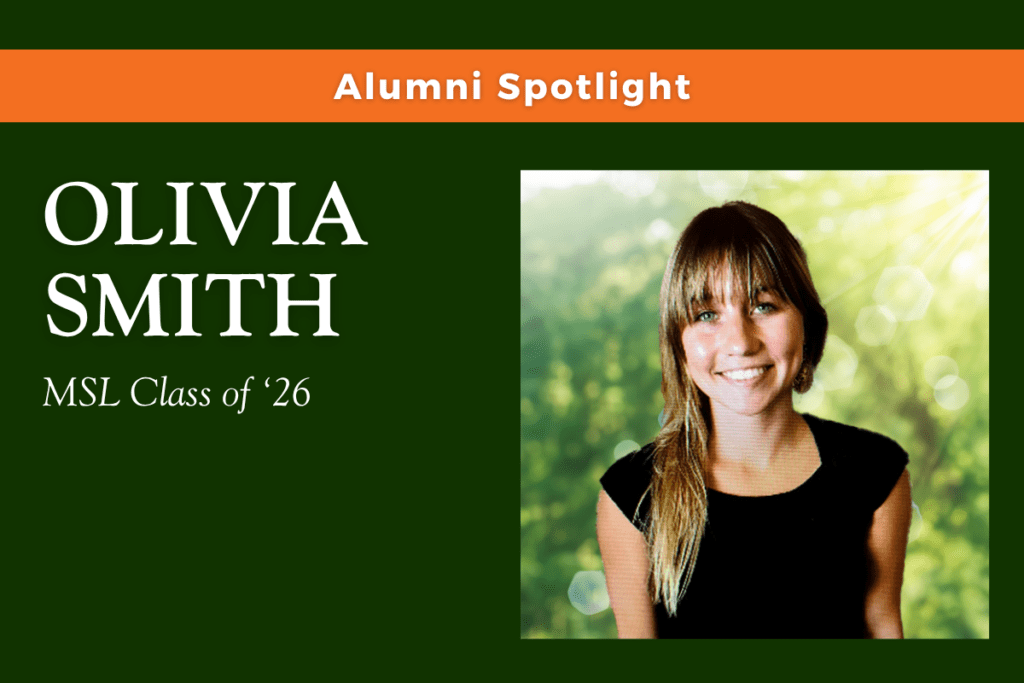
After earning her undergraduate degree, Olivia worked in a variety of environmental roles, from ocean acidification research to Superfund site cleanups, with an early focus on marine environments. Today, she works at a private consulting firm supporting utilities through complex regulatory processes such as hydropower relicensing, a multi-year federal effort that requires coordination across agencies, stakeholders, and communities.
“Dam removal is really where my passion lies, and it’s what I ultimately wrote my thesis about. That interest is what led me to pursue the Master of Studies in Law (MSL) in Environmental Law at Lewis & Clark Law School.”
Finding the Right Program
Olivia was working in a conflict resolution role on a complex project. “People were constantly using acronyms and referring to legal authorities. I knew what the terms stood for, but I didn’t really understand what they meant in practice. I was trying to teach myself on the job, and while I developed a basic understanding, I wanted a deeper foundation.” She did not, however, want to commit to a full JD program.
“I found the MSL program, and it felt like the perfect fit. It’s a self-paced program, I could keep my job, and I could gain a high-level understanding that would help me participate in those discussions from a more informed perspective.” Olivia ultimately chose Lewis & Clark for its reputation and specialized focus in environmental law. “It’s a top environmental law program, so you’re getting to learn from some of the premier professors and professionals in the nation.”
Becoming More Proactive
One of the biggest advantages of the program for Olivia was the ability to immediately apply what she was learning, since she was studying while working. “I’m getting things handed to me that I wasn’t before,” she says. “I felt behind, and now I can feel a little more proactive. I can talk the talk, and I understand more, because I stopped and learned about it. The MSL was really a great program just to complement and boost my understanding of these topics.”
Olivia’s bread and butter is hydropower relicensing, a multi-year process involving consultation with state and federal agencies and nonprofits, as well as making sure that the dams are in compliance with the Clean Water Act, the Endangered Species Act, and the Federal Power Act. “I wanted to pause and really learn about those laws in this program.”
Navigating an Online Degree
Completing the MSL fully online allowed Olivia to maintain her full-time job while earning her degree. “It took a lot of time management and discipline,” she says, but she learned how to structure her days in a way that worked for her. “Pacing yourself is important.”
As far as coursework, she found Wildlife Law with Professor Dan Rohlf and Water Law with Professor Karen Russell particularly impactful. “The professors were all very available, and I loved going to office hours,” she said. “And these were all topics I loved.” It was all highly relevant as well; she says that her final for the Water Law course was “basically what I now do at work.”
An Inspiring Community
When asked what one word she would use to describe the program, Olivia chose, “Genuine. I felt like all the professors were extremely genuine people that just believe in their students, and want the best for them, and are available to just pass on any and whatever knowledge that they’re willing to absorb. I really, really appreciated that quality in the program. Everyone was working on really important issues and it was just a really inspiring community.”
Would she recommend this program to others? “Absolutely,” Olivia said. “I already have.”